
Looking for a convenient, painless, at-home way to test your hormones (and more)? This blog dives deep into Rythm reviews- what Rythm tests for, is it right for you, is it worth it?
If you’re in perimenopause or menopause, you already know the drill with standard lab work is exhausting.
You book an appointment weeks out, sit in a waiting room flipping through outdated magazines, get a standard blood draw without knowing what’s included or covered, and then wait days for a basic panel that barely scratches the surface. This isn’t the story for every woman- but it’s a story told way too often!
It’s frustrating when your body is shifting rapidly, and you want real data to make informed decisions about hormone therapy, supplements, or lifestyle changes. Or even to help validate that something is off- and potential solutions to help!
Meanwhile, your hormones are fluctuating daily, your energy is tanking, your mood is a rollercoaster, and you’re left guessing whether your symptoms are from dropping estrogen, sluggish thyroid, or something else entirely.
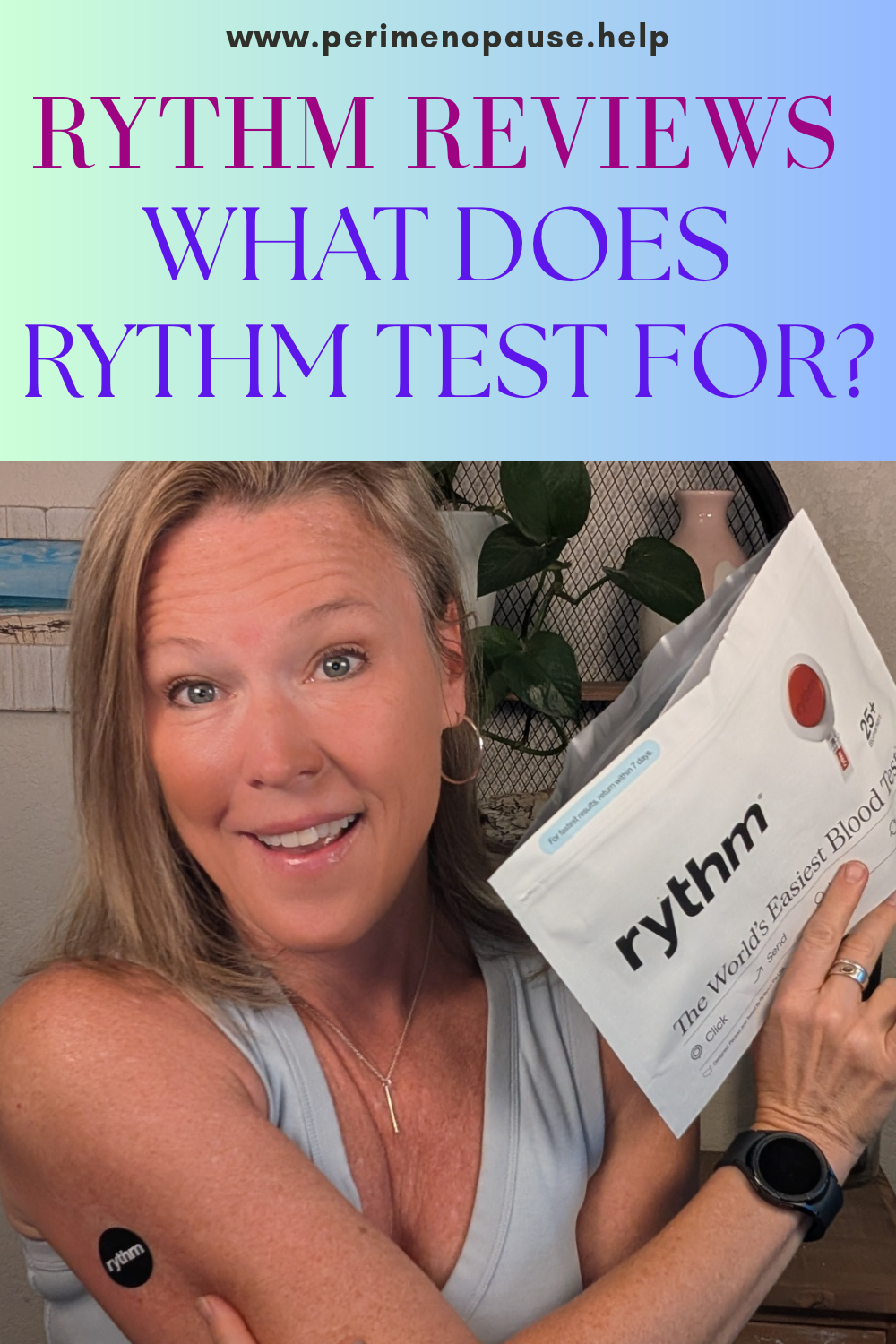
That’s why I’m breaking down the Rythm At-Home Blood Test in this review, a kit that measures over 25 biomarkers from your upper arm without a clinic visit.
What Makes Rythm Different From Every Other At-Home Test
Most at-home hormone tests are finger-prick kits or saliva swabs that do offer some insight, but typically only FSH or Estradiol, not usually a full hormone and cardiometabolic picture, which can all be extremely helpful in the perimenopause and postmenopause journey. More on these types of (typically urine-based) test kits here.
Rythm uses an upper-arm micro-collection device, and it’s painless, much more so than the finger-prick type at-home tests. The difference matters because capillary blood from the upper arm correlates far more reliably with standard venous draws than fingertip samples, which are notoriously inconsistent due to pressure variability and contamination from interstitial fluid. For women tracking perimenopause, where precision on estrogen, progesterone, and thyroid markers can make or break treatment decisions, this accuracy gap is not trivial.
The kit arrives with the micro-collection device, alcohol prep wipes, visual instructions that actually make sense, and a pre-paid return mailer with free home pickup available. Which is handy because you’re not hunting down a shipping box or standing in line at the post office. You prep your upper arm with the wipe, place the device firmly against the side of your arm, press the activation button, and feel a light suction with slight pressure. No deep needle jab. No squeezing sore fingertips until they bruise.
To see the whole process check out my video here:
In just a few minutes, the device automatically draws a small volume of capillary blood into the sealed container. You detach it, drop it in the return packaging, and either mail it or schedule a home pickup (in my experience, at home pickup was better; the first kit I took to a pack-and-ship facility was damaged by the time it got there).
What stood out to me immediately is how low-friction the entire process is (other than the damaged shipping situation I had). There’s no second-guessing whether you collected enough sample or contaminated it. The device does the work, and the instructions are clear enough that you won’t need to watch a tutorial three times before attempting it.
The 25+ Biomarkers Rythm Actually Tests
Here’s where Rythm separates itself from basic hormone panels that only check estrogen and/or progesterone and call it a day.
The test evaluates over 25 key biomarkers across hormones, metabolic health, cardiovascular risk, and organ function:
Sex and Pituitary Hormones:
- Estrogen (Estradiol, E2)
- Progesterone (female only)
- Total Testosterone
- Free Testosterone
- SHBG (Sex Hormone Binding Globulin, which controls how much testosterone and estrogen are actually available to your cells)
- Cortisol (your stress hormone that impacts energy, sleep, and weight)
- TSH, Free T3, and Free T4 for complete thyroid assessment (female only on T3 and T4)
This hormone panel alone is more comprehensive than what most gynecologists (and definitely what most primary care doctors) order during annual visits. Free testosterone and SHBG are especially critical during perimenopause because total testosterone can look normal while free testosterone is tanking, leaving you with low libido, muscle loss, and brain fog that standard panels completely miss.
However, if you have a functional medicine physician, hormone-focused provider, or integrative type practitioner, you may get a more comprehensive panel routinely.
Metabolic and Cardiovascular Markers:
- ApoB (the most accurate predictor of cardiovascular risk, far superior to standard LDL cholesterol)
- LDL Cholesterol
- HDL Cholesterol
- Total Cholesterol
- Triglycerides
- Remnant Cholesterol
- LDL-C / ApoB Ratio (shows cholesterol particle size)
- Total Cholesterol / HDL Ratio
- Triglycerides / HDL Ratio (a proxy for insulin sensitivity)
- hsCRP (high-sensitivity C-reactive protein, a marker of systemic inflammation)
- Fructosamine (tracks average blood sugar over the past two to three weeks, more stable than glucose)
- Uric Acid (linked to metabolic syndrome and cellular health)
The inclusion of ApoB is huge. Most standard lipid panels still rely on LDL cholesterol, which can underestimate cardiovascular risk, especially in women post-menopause when estrogen loss accelerates arterial plaque buildup. ApoB counts the actual number of atherogenic particles in your blood, giving you a far clearer picture of heart disease risk.
Ferritin, iron storage, and nutrient markers also make the list:
- Ferritin (critical for energy, hair health, and thyroid function)
- Vitamin D
- Albumin (protein status and liver function)
Low ferritin is epidemic among perimenopausal women dealing with heavy periods, and it mimics hypothyroidism with fatigue, hair loss, and cold intolerance. Standard annual panels often skip ferritin entirely, leaving women to potentially suffer with “normal” hemoglobin while their iron stores are depleted.
Kidney and Liver Function:
- Creatinine (kidney function)
- eGFR (kidney filtration rate)
- ALP (alkaline phosphatase, tracks liver and bone health)
- GGT (gamma-glutamyl transferase, a sensitive liver health marker)
For women on bioidentical hormone replacement therapy or considering it, having this full panel quarterly or even monthly makes dosage adjustments eaiser. You’re not flying blind between annual physicals. Hormone therapy can be complicated, and it’s not a cookie-cutter approach, so it’s helpful to take into account both hormone levels and symptoms to find the right fit.
How Accurate Is Capillary Blood From Your Upper Arm?
This was my biggest concern as a physician before testing it myself.
Rythm processes samples in its own CLIA-certified and CAP-accredited laboratory, cutting out third-party middleman labs that can delay results and compromise sample integrity. Clinical studies show high correlation between capillary blood micro-samples from the upper arm and standard venous draws for key hormones, lipid panels, and ferritin, provided the sample is processed promptly.
Because Rythm delivers results digitally in around 48 hours after the lab receives your sample, the turnaround time preserves sample stability. That speed matters. Capillary samples degrade faster than venous blood, so a system that sits in transit for a week is worthless. This is also why it’s important to send your sample quickly and follow all instructions.
The upper-arm collection site also reduces contamination risk compared to fingertip pricks. Fingertip blood can mix with interstitial fluid when you squeeze too hard, diluting the sample and skewing results. The upper arm avoids that variable entirely.
I compared my Rythm results to a standard venous draw I had done within the same week. Estradiol, progesterone, TSH, Free T3, ApoB, and ferritin were all within clinically acceptable variance. The differences were negligible, well within the margin you’d see between two venous draws taken on different days.
What You Actually Get in Your Results Dashboard
Rythm, via the website or the app, provides you with easy-to-understand results and ranges for both optimal and normal.
The dashboard gives you:
- Personalized biomarker insights: Plain-language explanations of what each marker means and why it matters for your health.
- Rythm Score: A composite score that tracks your overall health trajectory over time.
- Biological Age calculation: Based on your biomarker profile compared to population norms.
- Trends over time: If you test quarterly or monthly, you can see how estrogen, progesterone, thyroid, and metabolic markers shift, giving you and your doctor real data to guide treatment adjustments.
- Unlimited AI health coaching: You can ask questions about your results and get explanations without waiting for a doctor callback.
The trend tracking is a unique feature here. A single snapshot of estrogen or progesterone during perimenopause is almost meaningless because these hormones swing wildly week to week. Seeing your levels, and their ratios, over three to six months reveals patterns that actually inform treatment decisions, like whether you need progesterone support or if your estrogen is trending too low for symptom control.
The Real-World Experience of Using Rythm
Unboxing the kit, the first thing I noticed was how minimal and straightforward everything looked.
No confusing multi-step lancet systems or tiny collection tubes you’re supposed to fill to an exact line. The upper-arm device is a single-use applicator that looks like a small, flat disc. You peel off the adhesive backing, stick it to the side of your upper arm after cleaning with the prep wipe, and press the center button.
You feel a brief suction, a slight pressure, and that’s it. No sharp pain. The device does all the work, and within a few minutes, the collection chamber fills with the required sample volume.
Once it’s done, you peel it off, and be sure to click the sample tube into place properly, seal it in the biohazard bag provided, drop it in the pre-paid return mailer, and either put it in your mailbox or schedule a free home pickup through the Rhythm app. The entire process from unboxing to sealing the return package was pretty fast and painless. I did forget to mention earlier, though it says on the packaging, that you should fast for at least 10 hours overnight and drink plenty of water before the test.
The results arrived in my dashboard 48 hours after the lab received my sample, exactly as promised. The interface is clean, easy to navigate, and the AI coaching feature let me ask follow-up questions about my ferritin and Free T3 levels without booking a doctor visit.
What Could Be Better
No at-home test is perfect, and Rythm has a few limitations worth calling out.
The upper-arm device is single-use only. If the collection fails for any reason, you’d need to contact customer support for a replacement. I didn’t have any issues, but it’s worth noting that you can’t just retry immediately like you could with a fingertip lancet kit.
Insurance coverage is limited. Rythm is FSA and HSA eligible, which helps offset the cost, but you’re paying out of pocket unless your insurance plan specifically covers at-home lab testing. At $79 per test (or $59.25 or less with the 25% first-test discount through this link) and monthly subscription it’s far cheaper than paying cash rates at a lab, but it’s still an expense if you’re testing monthly.
The test panel is fixed. You can’t add custom biomarkers or remove ones you don’t care about. If you wanted to add, say, DHEA-S or free T4 (for males), you’d need to order a separate test elsewhere. That said, the 25+ markers they do include hit the most critical areas for perimenopause and metabolic health. I also wish they had FSH on their panel, which is a helpful marker to track over time in perimenopause; it helps you understand what stage of perimenopause you may be in, and/or if you have crossed over into menopause
Who Rythm is best suited for
Rythm makes the most sense for women in perimenopause or menopause who need frequent biomarker tracking to fine-tune hormone therapy or catch metabolic shifts early.
If you’re dealing with unpredictable symptoms like brain fog, weight gain, insomnia, or low energy, and your standard lab work keeps coming back “normal,” this test gives you the deeper data to figure out what’s going on. Tracking trends in your estrogen, progesterone, Free T3, ferritin, and ApoB (not to mention the others) over time is invaluable when you’re trying to optimize BHRT dosages or troubleshoot why you’re not responding to treatment.
It’s also a strong fit if you:
- Want to avoid the hassle of booking appointments, sitting in waiting rooms, and chasing down results from your doctor’s office.
- Prefer testing on your own schedule, at home, without the painful finger-prick experience of most DIY kits.
- Care about cardiovascular and metabolic health markers like ApoB, Triglycerides / HDL ratio, and fructosamine that standard annual physicals often skip (fructosamine can catch blood sugar imbalances that are more recent than a1c which tracks them over 3 months)
- Have an FSA or HSA and want to use those funds on proactive health tracking.
Who should skip Rythm testing?
If you’re not interested in tracking trends and only want a one-time snapshot, a standard lab order from your doctor is probably cheaper if covered by insurance. Or if you have good wholesale pricing or great insurance coverage and comprehensive testing through your current provider’s office, then you likely don’t need something like Rythm. Also, as I mentioned earlier, FSH is not included, so if this is important to you, then you may want to either skip Rythm or accompany it with an FSH from another at-home kit or lab draw from your provider’s office.
Rythm’s value compounds when you test regularly and use the trend data to make informed decisions over time.
It also may not be a good fit if you have a blood phobia. Even though it’s painless, there is still a tube of blood involved that you have to handle and send away.
Rythm takes the friction out of blood testing without sacrificing clinical accuracy. The upper-arm collection is painless, fast, and reliable. The 25+ biomarker panel is comprehensive enough to catch hormone imbalances, metabolic dysfunction, and cardiovascular risk shifts that standard annual labs routinely miss.
If you’re serious about understanding what’s happening in your body during perimenopause or menopause, and you want the convenience of testing from home with lab-grade results, Rythm could be a great fit if it’s within your budget. The 90-day money-back guarantee also removes the risk if you want to try it once and compare it to your standard lab work.
Check out my full perimenopause testing guide and my Understanding Perimenopause course to learn more about navigating this crazy journey!


Dr. Shelley Meyer is a board-certified family physician and Institute of Functional Medicine-certified functional medicine physician, as well as a Registered Dietitian. She is passionate about helping women navigate the roller coaster of perimenopause and postmenopause. She has her own Functional Medicine Practice in Denver, Colorado.








Leave a Reply
You must be logged in to post a comment.