
Wondering about the connection between menopause and blood sugar- and how that affects your mood, body, and overall health? In women over age 40, the ages of perimenopause and into menopause, insulin resistance rises often leading to increased blood sugar long term. Let’s dive into why and what you can do about it!
You have been doing everything right, or so you thought.
You have cut carbs, walked after dinner, tried intermittent fasting. Yet that stubborn weight around your middle refuses to budge, your energy crashes by 3 p.m., and you wake up starving despite eating a solid dinner. If you are in perimenopause or menopause, these are incredibly common and not something you are doing wrong. They can be signals that insulin resistance has settled in, often silently, as estrogen declines and your metabolism rewrites its own rulebook.
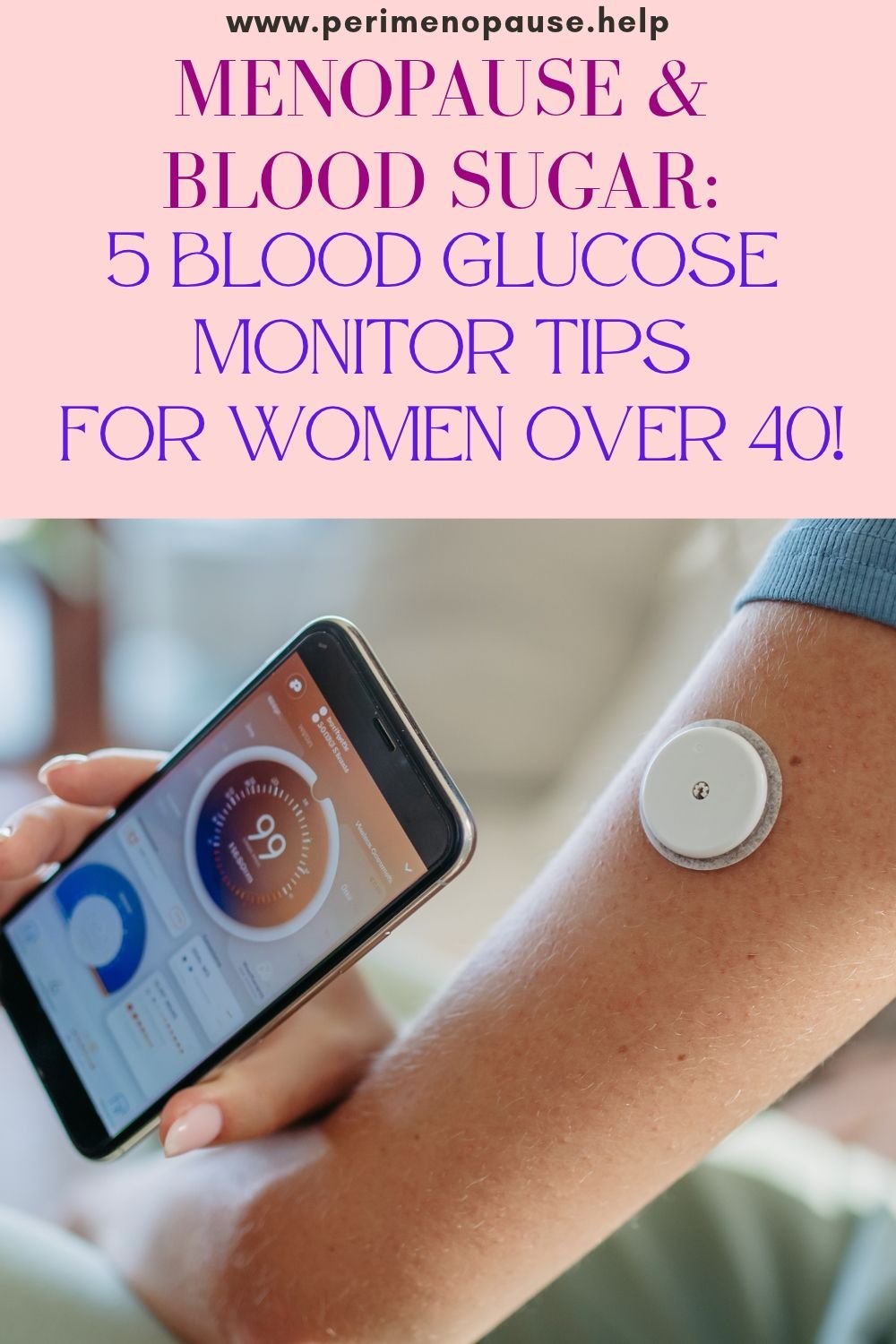
A blood glucose monitor, specifically a continuous glucose monitor or CGM, changes the guessing game into a feedback loop you can actually use. It does not judge your food choices or shame you for that late-night snack. Instead, it shows you in real time how your unique body responds to meals, sleep quality, stress, and movement.
This guide walks you through exactly how to wear the monitor, read the data, identify your personal triggers, and use what you learn to improve insulin resistance without obsessing over perfection.
What Insulin Resistance Looks Like on a Glucose Monitor
Insulin resistance does not always announce itself with a diagnosis- and it doesn’t show up as diabetes or even prediabetes every time. For many perimenopausal and menopausal women, it shows up as unexplained weight gain, especially around the belly, stubborn fat that will not respond to calorie restriction, cravings that feel impossible to control, and energy that nosedives between meals. When you strap on a glucose monitor, insulin resistance has a visible signature.
You will see:
- Large spikes after meals that contain carbohydrates, even ones you thought were healthy
- A slow crawl back to baseline that takes three or more hours instead of one to two
- Higher morning readings after a night of poor sleep or a late dinner
- Glucose that climbs when you are stressed, even if you have not eaten anything
This is not about having diabetes. It is about seeing how your cells are struggling to respond to insulin, the hormone that moves glucose out of your blood and into your muscles and liver. When insulin stops working efficiently, glucose stays elevated longer, your pancreas pumps out more insulin to compensate, and that excess insulin tells your body to store fat, especially in your belly or midsection.
The monitor makes the invisible visible. Data can help us make changes and start addressing the biology that is actually running the show.
How to Wear the Monitor So the Data Are Actually Useful
Slapping on a sensor for a few days and calling it an experiment will teach you almost nothing- you need to be a detective and carefully track the data in order for this to be worth it.
Glucose is influenced by what you ate yesterday, how you slept last night, the walk you took this morning, the argument you had at lunch, and whether you are fighting off a cold. A single reading is a snapshot. A pattern across 10 to 14 days is a map. Wear the sensor long enough to repeat the same meals on different days, test a habit change more than once, and see how your cycle, stress levels, and sleep quality all shift the curve.
Log more than just food:
- The exact moment you start eating, not when you finish
- Portion sizes, even rough estimates
- What you ate first, protein and vegetables or bread and fruit, for example
- A 10-minute walk, a strength workout, or a completely sedentary day
- Poor sleep, high stress, illness, or any steroid medications
Check the trend arrow alongside the number. A steady reading of 110 mg/dL means something completely different than 110 and climbing fast. Look at patterns across multiple days. A single spike after oatmeal does not mean oatmeal is necessarily bad for your blood sugar. It means you need to test oatmeal again on a different day, after better sleep, with protein on the side, and at a different time of day.
If a reading looks wildly high, wildly low, or just does not match how you feel, confirm it with a fingerstick before you panic or change your entire meal plan. The first day of sensor wear is often noisier than the days that follow. If a number only looks strange while you are lying directly on the sensor, note it and recheck when you stand up. Treat symptoms and patterns, not a single odd number that might be a sensor glitch.
How to Read Your Results Without Spiraling
Your monitor will flood you with numbers. Time in range, time above range, time below range, average glucose, estimated A1c, variability scores. Do not let the data paralysis set in.
Focus on three core metrics together, not in isolation:
- Time in range (70 to 180 mg/dL): This is the share of your day spent in a target range commonly used for diabetes management. If you do not have diabetes or prediabetes, your time in range will likely be much higher, around 95% or more. If you are working on insulin resistance, your clinician may set a tighter range. Ask before you start so you know what you are aiming for. Progress happens in 5% increments. Going from 60% to 65% time in range matters, even if it doesn’t feel dramatic.
- Time above range (over 180 mg/dL): This is how much of your day you spend running high. For people with diabetes, the target is often under 25%. For insulin resistance work, you want this number as low as possible because prolonged elevation is what drives more insulin release and more fat storage.
- Time below range (under 70 mg/dL): Brief dips under 70 can happen even in people without diabetes, especially after exercise, during sleep, or a long gap between meals. The goal is typically under 4%. If you are spending significant time low, that is a separate problem that needs attention.
A beautiful, perfect-looking average glucose can hide wild swings. You can have an average of 100 mg/dL and still be spiking to 180 after breakfast and crashing to 65 before lunch. Variability matters as much as the average. Steady days are the goal because large blood sugar swings stress your system, increase inflammation, and make insulin resistance worse over time.
Pay attention to your after-meal rise. Watch how far and how long your glucose climbs in the two to three hours after you start eating. You want smaller rises and a faster return to your pre-meal baseline. This is where you test foods, meal timing, and the order you eat things.
Two warnings: Don’t treat the monitor’s estimated A1c as a lab result. The same average glucose can produce different A1c numbers depending on how your red blood cells behave, so this is an estimate only. And do not chase a flat line by skipping meals. Some people see their glucose stay beautifully stable when they stop eating. That is not the goal. You need to learn how to eat in a way that stabilizes glucose, not avoid food altogether.
Using the Data to Improve Insulin Resistance in Perimenopause and Menopause
What spikes your glucose might be completely fine for someone else because personal features like your gut microbiome, muscle mass, stress hormones, overall hormone balance, family history, and sleep debt all shape how your body handles a meal. This is why you cannot just follow a generic “good foods, bad foods” list and expect it to work. You have to test your own responses.
Start with a one-week baseline. Change nothing except logging. Eat normally, sleep like you normally do, and move how you normally move. This week shows you where you are starting from. You cannot measure progress if you do not know your baseline.
Then pick one change and test it for three to four days:
- Meal order: Eat protein, fat, or non-starchy vegetables before you touch the carbohydrate part of your meal. This slows gastric emptying, meaning less of a hit to your blood sugar, and changes the gut hormone signals that affect glucose and insulin. It works. Studies show it can significantly blunt the after-meal spike.
- Fiber and whole-food carbs: Swap refined grains for whole grains. Add more non-starchy vegetables. Higher fiber lowers after-meal glucose and insulin, and improves insulin sensitivity over time in people with prediabetes and diabetes. Fiber also helps with regular bowel movements which help weight, and can lower LDL (bad) cholesterol.
- Protein with resistant starch: Pair your starchy carbs with a protein source. Think sweet potato with chicken, or oatmeal with Greek yogurt. The combination can lower the insulin response compared to eating the starch alone.
- Sleep extension: If you are a chronic short sleeper, try going to bed 30 to 60 minutes earlier. Even two weeks of better sleep can improve insulin sensitivity and reduce glucose swings. Sleep is not a luxury. It truly is a glucose-lowering intervention.
- Eating earlier in the day (and eating your carbohydrates earlier in the day): The same meal will produce a larger glucose spike at 9 p.m. than it will at 6 p.m. Your circadian rhythm affects how your body processes carbohydrates. If you are eating late because of your schedule, this is a variable worth testing. It can also help to eat most of your carbohydrates earlier in the day. This is due to the way insulin is released, with more being released in the earlier daytime hours, and less late in the day.
Keep everything else the same while you test one variable. If you change your dinner timing, your sleep schedule, and your breakfast composition all in the same week, you will have no idea which change moved the needle. Compare your time in range, your after-meal rise, and how quickly you return to baseline. Keep what works. Drop what does not.
People who use a monitor with simple feedback often naturally shift toward more vegetables, higher fiber, less added sugar, and more walking once they can see the immediate effect. The monitor turns abstract advice into clear cause-and-effect data.
How to Identify Your Personal Trigger Foods
You may have been told for years that white rice is bad, that fruit spikes blood sugar, that bread is the enemy. Maybe that is true for you. Maybe it is not. A continuous blood glucose monitor can help you identify your triggers.
The only way to know is to run a fair test. Check your glucose right before you eat. Eat a normal portion of the food in question. Log the food (and all CGM devices have apps where you can log your food), the amount, and what you ate first. Watch the next two to three hours. Note the peak and whether you are back near your starting number by the three-hour mark.
Then repeat that same food on a different day before you call it a trigger. One bad reading can be the result of poor sleep the night before, a meal eaten too late, a larger portion than usual, or high stress earlier in the day. If the same food reliably causes a large rise or stays above your target for a long time across multiple tests, then it is a personal trigger for you.
Carbohydrate amount is still the strongest driver of the glucose rise for most people, but the pattern can differ between men and women. Women may see more variability tied to their menstrual cycle, even in perimenopause when cycles become irregular.
Common patterns worth testing, and likely to contribute to adjustments you may make:
- Large portions of refined starch or added sugar, especially when eaten first on an empty stomach
- Fruit juice or any other liquid sugar that hits your bloodstream fast
- A high-carb meal eaten late at night when your insulin sensitivity is naturally lower
- A “healthy” food you personally spike from, like bananas, rice, or certain types of bread, even whole grain
A food spike or trigger does not always mean you need to totally avoid that food. It can be a dose problem, a timing problem, or a pairing problem until proven otherwise. Before you eliminate that food, try it in a smaller portion, after protein and vegetables, or earlier in the day. You may find that oatmeal after a veggie omelet behaves completely differently than oatmeal eaten alone at 7 a.m. on an empty stomach.
Other Triggers to Log Besides Food
If your glucose is high and you also slept terribly and ate dinner at 10 p.m., you cannot tell which factor mattered most. Change one variable at a time, that’s the name of the game here.
Track these alongside your food log:
- Short or broken sleep: Expect a higher, less stable glucose day after a night of poor sleep. Sleep deprivation makes your cells more insulin resistant, even if your diet does not change. Protecting your sleep is as important as choosing the right foods. If you can’t sleep, you may want to check your hormones– both low progesterone and estrogen, and imbalanced cortisol or thyroid hormones can impair your sleep.
- Late meals: Your body handles carbohydrates differently at 9 p.m. than it does at noon. The circadian rhythm affects insulin sensitivity. If you see consistent spikes after late dinners, even when the meal itself is not particularly high in carbs, meal timing is your variable.
- Stress and inactivity: A stressful day or a completely sedentary day can raise glucose even when food intake stays the same. Cortisol, the stress hormone, raises blood sugar. People using monitors often see the link between their emotional state and their glucose curve, not just their meals.
- Illness or steroid medications: If your readings jump for a day or two without any diet changes, look at whether you are fighting off a cold or taking a medication like prednisone. Both can spike glucose temporarily.
- Exercise timing: Do not assume a workout will always lower your next reading. Intense exercise can temporarily raise glucose due to adrenaline and cortisol release. Compare the same meal with and without a 10-minute walk to see your own pattern.
What Better Looks Like After One to Two Weeks
Judge your progress over one to two weeks, not one meal or one day.
You are looking for more time in the range you and your clinician agreed on. You want smaller after-meal rises and a faster return to baseline. You want fewer days with wild swings where your glucose looks like a roller coaster. You want to feel less need to “recover” from a single food for the rest of the day. And ideally, you will see better morning fasting readings after you prioritize longer, better sleep.
Bring your log to your next medical visit. This helps you and your healthcare provider figure out your patterns, adjust your diet and lifestyle, and use real data to make your treatment plan work for you!

Dr. Shelley Meyer is a board-certified family physician and Institute of Functional Medicine-certified functional medicine physician, as well as a Registered Dietitian. She is passionate about helping women navigate the roller coaster of perimenopause and postmenopause. She has her own Functional Medicine Practice in Denver, Colorado.








Leave a Reply
You must be logged in to post a comment.